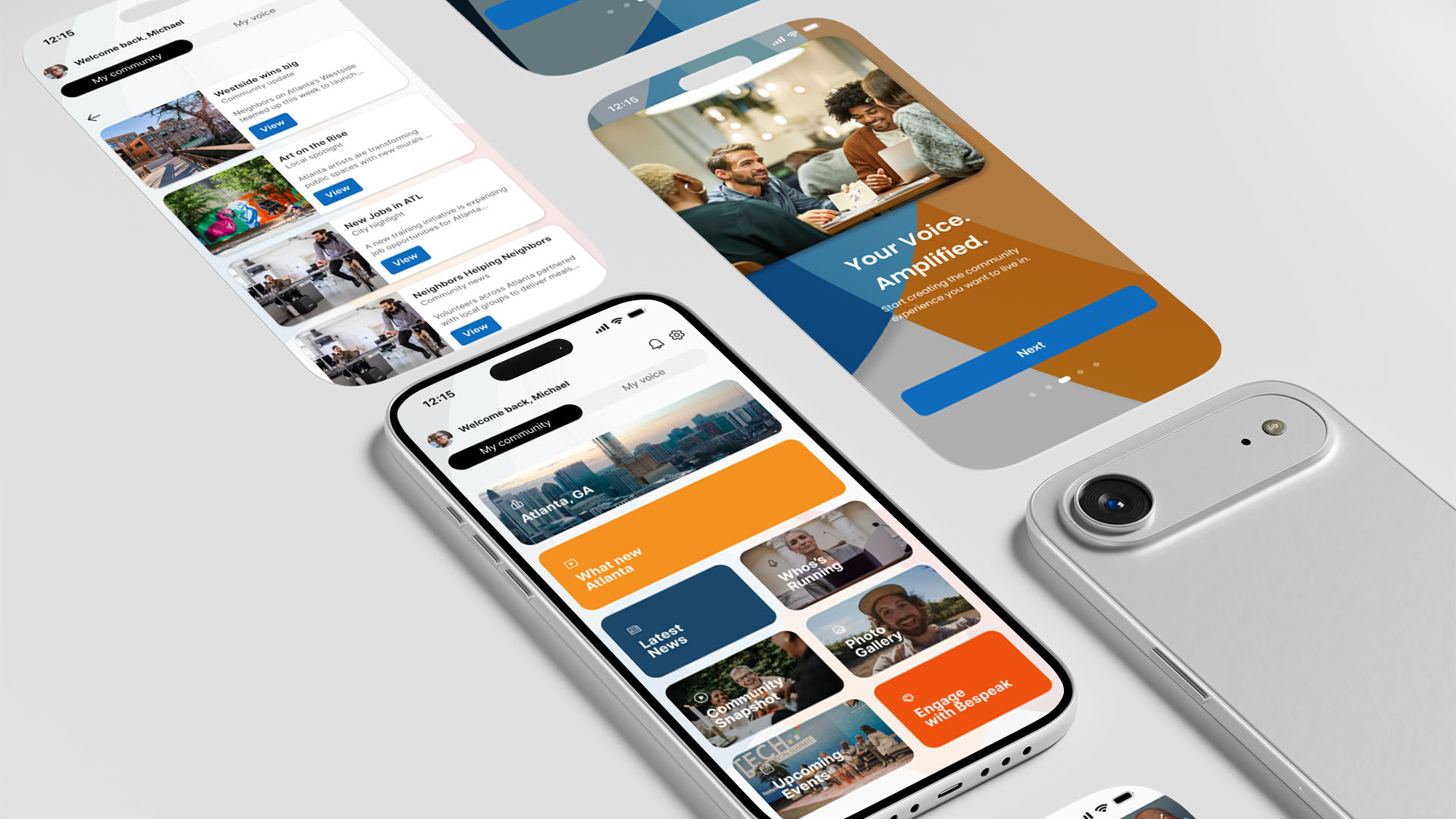
Bespeak is an ongoing platform, piloted across BeltLine-adjacent Atlanta neighborhoods, built to prove that a role-based, plain-language approach to civic engagement can close the trust gap between residents and the decisions that reshape where they live.
Bespeak began as a response to what was happening across Atlanta's BeltLine-adjacent neighborhoods, communities like Westview and the area around Pittsburgh Yards, where rising costs and cultural displacement were outpacing residents' ability to influence the decisions reshaping their own blocks. In early discovery interviews, planners told us the same thing directly: engagement was happening too late to influence the outcome.
The tools in place weren't built to close that gap. Static surveys, fragmented communication across departments, and siloed committees left residents guessing at what was actually being decided, and many carried real, earned mistrust of digital systems that extract input and give nothing back. Over 80% of residents surveyed said they didn't understand the planning process well enough to weigh in on it. That gap, not a lack of interest, was the design problem.
The work began with community listening, sessions with residents, youth leaders, nonprofits, and property managers across the neighborhoods Bespeak was designed to serve. Rather than starting from a feature list, I was listening for what residents actually needed to trust the process: to understand it, to see their input reflected, and to find people like them already engaged.
Three pillars came out of that listening and shaped everything downstream: accessibility, transparency, and collective intelligence. From there I built a multi-layered service blueprint mapping resident touchpoints, administrator workflows, data flows, and decision lifecycles, then architected a unified platform on top of it, with clear openings for AI to help summarize community input rather than replace the people giving it.
In its current build phase, I took the platform from that blueprint into a working, role-based product myself, modeling resident, community leader, city planner, business owner, and admin permissions directly into the data model on Next.js, PostgreSQL, and Prisma, so the system stayed legible as it scaled instead of accumulating one-off exceptions.
Every account belongs to a role, resident, community leader, city planner, business owner, or admin, and that role determines what they see across Issue Boards, decision tracking, and every other module: who can publish a timeline, who can moderate a discussion, who can close the loop on a decision.
Designing the role model first meant the interface for each role could stay simple and specific, instead of one generic dashboard trying to serve everyone at once.
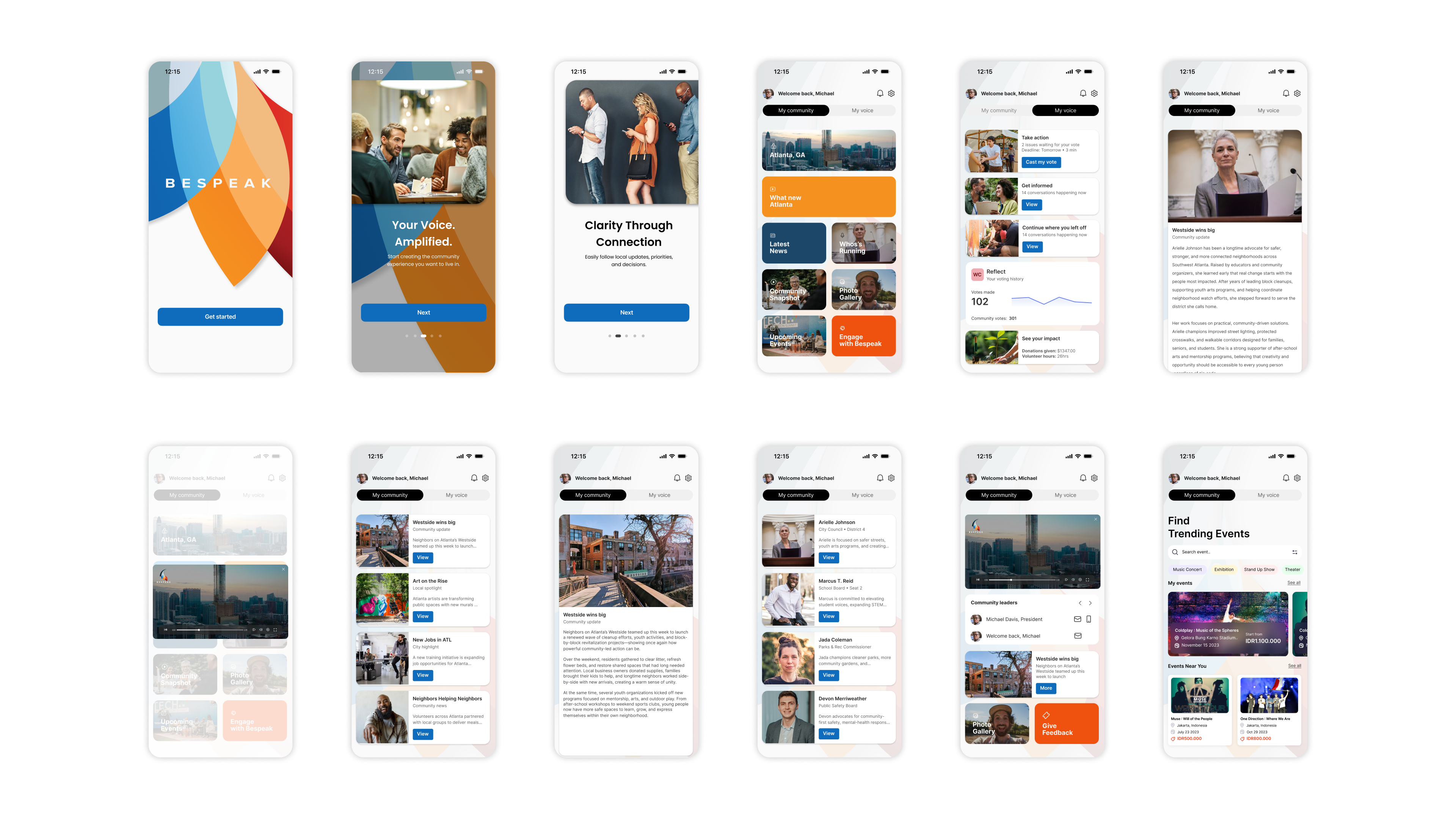
Rather than a single feed, Bespeak organizes engagement into purpose-built modules, each designed around a specific way residents build trust in the process.
Bespeak's design system was built to scale across neighborhoods without a redesign for each one, brand identity, accessibility standards, mobile-first patterns, and a component library meant to outlast any one release. In its current build phase, I also took the platform itself from that system into working, full-stack code.
Working across strategy, UX, and code meant every feature was scoped against what could actually ship, a discipline that kept the platform focused instead of sprawling.